
Quick answer: A running nose in a child is almost always a viral cold, and it clears in seven to ten days without medicine. Saline drops, gentle suction, fluids and sleep do more than any syrup. Green mucus on its own doesn’t mean your child needs antibiotics. See a doctor if it lasts beyond ten days, gets better and then worse, comes from one nostril with a bad smell or comes with fast breathing or a fever that won’t settle.
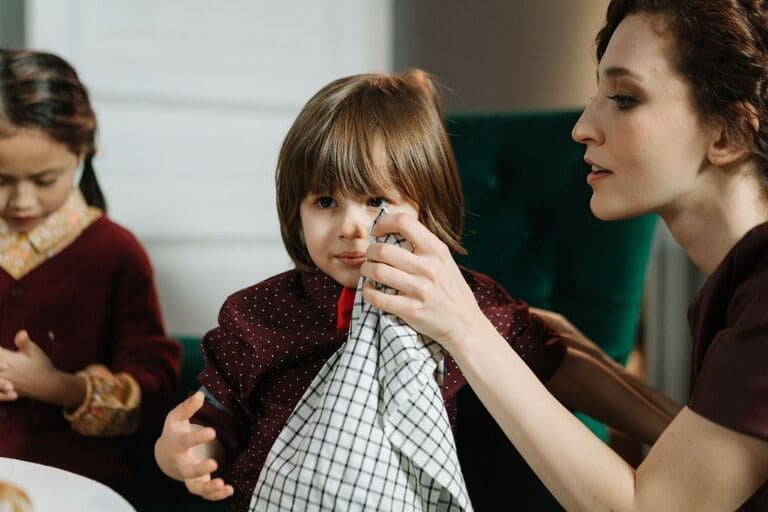
Through a closed door at two in the morning, I can tell when my daughter’s nose is running. A sniff, a short pause, then a swallow. By the fourth night I’m usually awake with the same loop of questions. Is this normal? Is it an allergy? Has it gone into her sinuses? Should we see the doctor?
Most of the time the answer is reassuring. Here’s how to spot the times it isn’t.
Why does my child’s nose keep running?
Mucus isn’t the problem. It’s the nose doing its job. Every nose makes mucus all day to trap dust, pollen and viruses before they reach the lungs, and during a cold the lining swells and makes far more of it. What you’re wiping off is the body flushing the infection out.
The Ministry of Health and Family Welfare’s standard treatment guidelines call the common cold “usually a self-limiting illness of short duration” and say it needs no specific treatment. Nearly every cold is viral. Your child’s immune system does the work.
The guidelines do flag one thing. About one in five children with a viral cold goes on to get an ear infection, so keep a closer eye on the ears, the fever and the breathing than on the snot.
Common causes of a running nose in children
Parents usually assume a cold. Often it is one, but four causes cover nearly every case.
A viral cold
By far the most common. Expect a runny nose, sneezing, a mild fever, a sore throat and a bit of cough over seven to ten days. Young children catch six to eight colds a year, and a child in playschool can seem unwell all winter because the next cold arrives before the last one has cleared. Our guide to cold and cough in kids covers the full illness, day by day.
Allergic rhinitis
In Indian cities pollen is only part of the story. Dust mites, pet dander, mould on damp walls, agarbatti and mosquito coil smoke and vehicle exhaust all set it off. A study of severe allergic rhinitis in central India found house dust mite was the top trigger, in close to 48% of patients. The Indian Academy of Pediatrics (IAP) also lists Diwali firecrackers and Holi colours among outdoor triggers.
Enlarged adenoids
Most Indian parents have heard this word in a clinic at some point. Adenoids are pads of lymph tissue at the back of the nose, and they’re largest between the ages of two and six. When they swell, they block the nose from behind. The child sounds stuffy all the time, breathes through the mouth, snores and never quite clears. Adenoids usually shrink again by the teens.
Irritants, or something stuck in the nose
Smoke, a dry AC room, winter air and air pollution can all make a nose run with no infection at all. Discharge from only one nostril that smells foul is a different thing. Toddlers push beads, peanuts and bits of foam up their noses, and a doctor needs to take the object out. Don’t go in with tweezers at home. If it could be a button battery, go to emergency straight away, because it can burn the inside of the nose within hours. Our babyproofing checklist covers how to keep batteries and small objects out of reach.
Cold or allergy: how to tell the difference
| Cold | Allergy | |
|---|---|---|
| Onset | Over a day or two | Sudden, after exposure |
| Discharge | Runny, then thick | Watery, keeps going |
| Itching | Rare | Itchy nose, eyes and throat |
| Sneezing | Now and then | Frequent, in bouts |
| Fever | Sometimes, low-grade | Never |
| How long | Seven to ten days | Weeks, months or all year |
If the honest answer to “does it ever stop?” is no, and there’s never any fever, you’re looking at allergy, not bad luck. Other clues are dark circles under the eyes and a child who keeps rubbing the nose upwards with a palm. Itchy, watery eyes often come along with an allergic nose, and air pollution can set off both. Allergic rhinitis is worth treating properly. The IAP notes that around four in ten children with it go on to develop asthma, so ask your paediatrician about it rather than waiting for the child to grow out of it.
How to treat a running nose at home
- Saline drops, then suction. Put two or three drops in one nostril, wait a few seconds, then suction gently with a bulb or nasal aspirator. Repeat on the other side. For a baby who can’t blow their nose yet, nothing helps more. Do it before feeds and before sleep. Both belong in your home first aid kit.
- Fluids. Water, clear soup, breast milk or formula. Don’t fight over food for a few days. Thin mucus drains more easily, and our guide to keeping children hydrated shows how much a child needs at each age.
- Rest, with the head raised for older children. Put a folded towel or pillow under the head end of the mattress instead of stacking pillows under the head. Babies under one should sleep flat on a firm mattress with nothing in the cot, even with a cold.
- A cool-mist humidifier if the room is dry. Clean it every day or two. A dirty one sprays mould into the air and does more harm than none.
- Gentle home remedies. Warm ginger-tulsi water, haldi doodh and a warm bath are all fine. The MoHFW guidelines list ginger, tulsi and herbal tea as safe for children over six months, and breast milk for younger babies. They also list honey, but hold it back until after the first birthday because of the risk of infant botulism.
What not to give a child with a running nose
The government guidelines name three things to avoid for a child with a cold: cough syrups, antihistamines and decongestants.
Cough and cold syrups. Many contain codeine, alcohol or sedating antihistamines. They don’t clear mucus, and they can leave a child too drowsy to feed or to keep their airway clear. The IAP says not to give them without a doctor’s advice, and the health ministry has told doctors not to prescribe cough syrups to children under two at all.
Decongestant nose drops like Otrivin or Nasivion for more than three days. Most Indian homes keep a bottle, so this is the one I most want parents to hear. The drops open a blocked nose fast for a day or two. After that the nose gets used to them, and when each dose wears off it swells up worse than before, so you reach for the bottle more often. Doctors call this rebound congestion. Saline doesn’t do it. Check with your doctor before using decongestant drops in a child under six.
Steam from a bowl of boiling water under a towel. There’s little evidence it helps, and children get scalded this way every winter. A steamy bathroom after a hot shower gives the same comfort with none of the risk. Keep menthol and eucalyptus rubs away from children under two.
Antibiotics because the mucus turned green. This one needs its own section.
Does green snot mean my child needs antibiotics?
No. Yellow or green mucus doesn’t mean a bacterial infection. The colour comes from white blood cells the body sends to fight the virus. Most colds run clear, then cloudy, then yellow or green, then clear again as they end. Giving antibiotics for colour alone puts children on medicine they don’t need and helps bacteria build resistance.
What matters is how long the running nose lasts and which way it’s heading.
When to see a doctor for a child’s running nose
Book an appointment if:
- It lasts more than ten days without getting better
- Your child improves, then gets worse again
- A fever of 39°C or more comes with thick discharge for three days in a row, or the fever comes back after a clear day
- There’s face pain or pressure, or bad breath that doesn’t go away
- Your child has ear pain or keeps pulling at an ear
- The discharge comes from one nostril only and smells bad
The first four suggest bacterial sinusitis, the one case where antibiotics do help.
A child who is blocked all the time, breathes through the mouth, snores or has pauses in breathing during sleep probably doesn’t have one cold after another. That pattern points to allergy or adenoids and calls for an ENT referral, not another bottle of syrup.
Red flags: go to the doctor today
Go the same day, or to emergency if it’s severe, if you see:
- Fast breathing, the skin between the ribs pulling in, or flaring nostrils
- Blue or grey lips
- A fever of 38°C or above in a baby under three months
- A child who won’t drink, hasn’t passed urine in hours, or cries without tears
- Unusual sleepiness, confusion, or trouble waking
- A seizure, or a stiff neck with fever
- Swelling or redness around one eye
- A rash that doesn’t fade when you press a glass against it
- High fever with severe body and joint pain, or bleeding from the gums or nose

Running nose in Indian monsoons and winters
From July to September, a fever is more likely to be dengue or typhoid than a cold. Dengue comes on suddenly with a high fever, a bad headache, pain behind the eyes and heavy body and joint pain, and it rarely brings a running nose. A cold builds slowly. If dengue is a possibility, give paracetamol only. Never aspirin or ibuprofen, because they raise the risk of bleeding. Our guide to kids’ health while travelling covers which mosquito repellents are safe for children.
Plenty of us grew up with a warm mustard oil rub on the chest during a cold. It’s soothing, though it does nothing for the mucus. Putting oil or ghee inside a baby’s nose is a different matter. Oil can slip down into the lungs, so skip it, as our guide to baby massage oils explains. For which other family traditions hold up, see Indian grandmother newborn care tips. And if the running nose keeps coming back, the cause is usually an allergy, the adenoids or a trigger at home, not the weather or a missed ritual.
Questions parents often ask
How long does a running nose last in a child?
A cold-related running nose usually clears in seven to ten days. A cough can hang on for two to three weeks after the nose dries up. An allergic running nose lasts as long as the trigger is around.
Is a running nose contagious?
If a cold is behind it, yes. Children spread it most in the first two to three days. A running nose from allergy or adenoids isn’t contagious.
Can I send my child to school with a running nose?
If there’s no fever and your child is eating, drinking and playing normally, school is usually fine. Keep them home while they have a fever. Teach them to sneeze into an elbow and wash hands before meals. Our cold and cough guide has the full return-to-school rule.
How often can I use a nasal aspirator on my baby?
Three or four times a day is enough, ideally before feeds and sleep. Suctioning more often than that can irritate the lining of the nose and make the swelling worse. Always put in saline first.
If your gut says something is wrong, trust it. You know how your child breathes and feeds better than any checklist does.
References
Ministry of Health and Family Welfare, Government of India. Standard Treatment Guidelines: acute respiratory infections in children (common cold).
Indian Academy of Pediatrics. Allergic rhinitis: guidance for parents.
Study of allergens in severe allergic rhinitis, central India (house dust mite sensitisation).
Directorate General of Health Services, Ministry of Health and Family Welfare. (2025). Advisory on rational use of cough syrups in paediatric population. Reported by News On AIR: https://www.newsonair.gov.in/health-ministry-advises-cough-syrups-should-not-be-prescribed-or-dispensed-to-children-below-two-years
Wald, E. R., et al. (2013). Clinical practice guideline for the diagnosis and management of acute bacterial sinusitis in children aged 1 to 18 years. Pediatrics, 132(1), e262-e280.
American Academy of Pediatrics. (2024). Coughs and Colds: Medicines or Home Remedies? HealthyChildren.org. https://www.healthychildren.org/English/health-issues/conditions/chest-lungs/Pages/Coughs-and-Colds-Medicines-or-Home-Remedies.aspx
American Academy of Pediatrics. (2022). Sleep-Related Infant Deaths: Updated 2022 Recommendations for Reducing Infant Deaths in the Sleep Environment. Pediatrics, 150(1).